Remember the “broken-phone” game? Twenty kids whisper a phrase down a line, and by the end “The cat sat” becomes “Attack Saturn!” In tech we still play that game just with product requirements and Jira tickets instead of crayons. The culprit? Layers. Layers in code, layers in org charts, layers in process. Each one promises “structure” but quietly taxes clarity and momentum until products die and get re-written.
Code Layers
- Inheritance Inception – Five levels of base classes so deep you need scuba gear. Change a property in
BaseController<T>and half the app explodes. - Repository-Service-Manager-Facade Bingo – CRUD that pings through multiple hops before touching a database. By the time the business rule runs, no one remembers why the call began.
- Microservice Matryoshka – Tiny nanoservices for everything: a “UsersGateway” that calls a “UsersBridge” that calls a “UsersStore.” Great for Cloud bills (when you ‘re not the one paying for them) and lousy for debuggers.
Why?
Future proofing (YAGNI at its best). We have developers over-engineering for stuff that will never be asked. Then we have the “CV Engineers”. Engineers that add tech just so they can mention it on their CV. Let’s add X library or let’s add Y in our pipeline, sounds familiar? If not then this should, “Clean Code”. A lot of developers use this phrase without having even read the book or knowing why this term was even created. Then you see the architecture inside the project and you need to call a psychic to understand why there are 10+ layers between an API call until you reach a data store to reply!
Organizational Layers
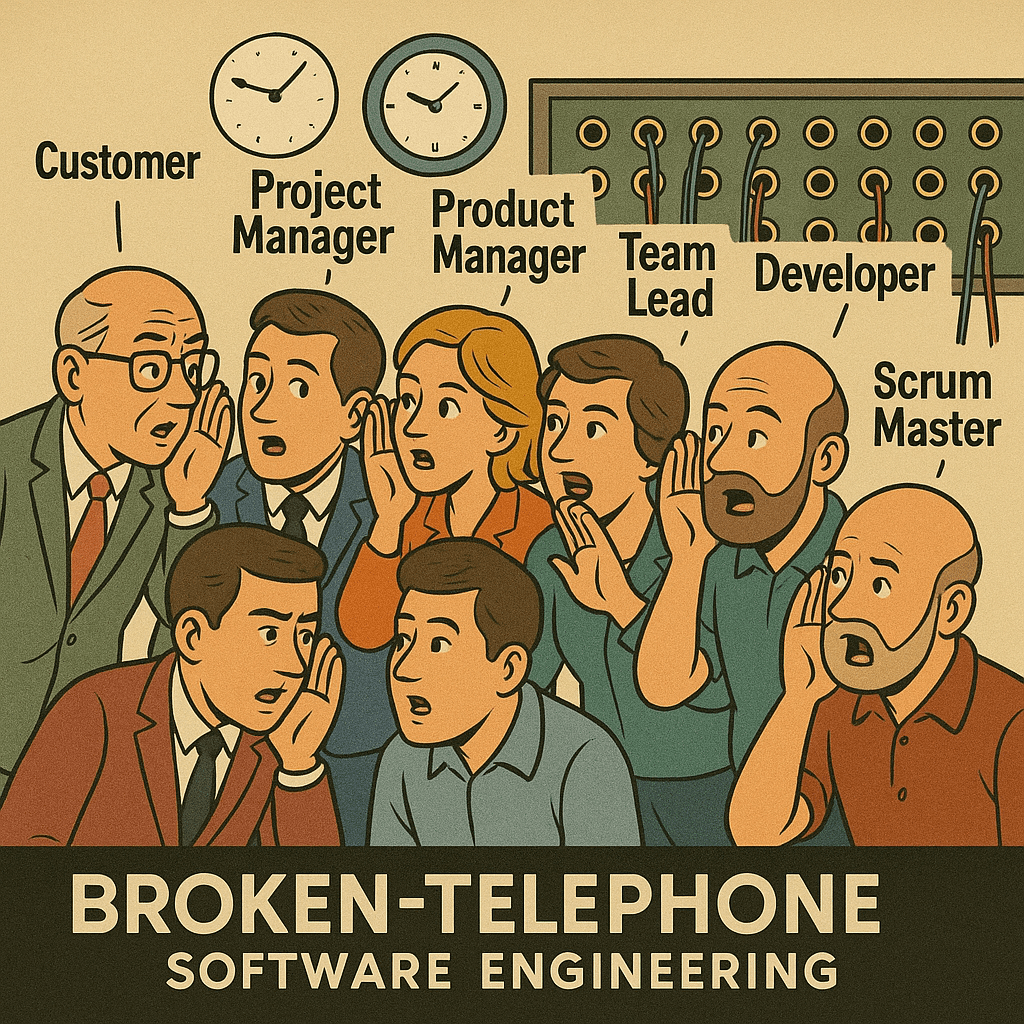
Layers aren’t confined to the IDE. A feature request can bounce from customer → account exec → product manager → project manager → team lead → dev. Each relay distorts the “why,” just like broken-phone. How many times, have YOU as a dev been dragged into a meeting with a stakeholder to realize that the thing you ‘ve worked for the past X days, was completely wrong?
The result? Cycle-time creep. Weeks vanish in “sync-up meetings” while competitors ship.
Spotting a Deadly Layer Early
- The 10-Minute Rule – If you can’t trace a request from UI to data store in under ten minutes, it’s probably over-layered.
- Meetings – If you see a lot of meetings instead of asynchronous ways of communication (slack, teams, Jira), time and money is being wasted.
- Abstraction Ratio – Count concrete classes vs. interfaces/abstract classes. When the ratio flips (>1:1), maintenance cost skyrockets. If you need someone to help you debug a request (given you are not an entry level developer), there is a problem with the code.
How to Peel Back the Onion
- Collapse Redundant Abstractions – Merge
IThingService,ThingService, andThingManagerinto one thing. Don’t abstract just for fun. - Refactor to Vertical Slices – Group feature code by behavior, not technology layer.
- Flatten Decision Paths – Empower devs to talk directly to designers or customers. A dev should not be involved at the last second when the deadline is already close.
- Run a “Layer Audit” Workshop – Whiteboard your call stack / org chart, then vote on what to delete. The most crossed-out box usually deserves it.
- Measure & Celebrate Simplicity – Track cycle time, lines removed, meetings canceled. Gamify the purge!
Conclusion
Take five minutes today: pick one feature, follow its journey—both in code and in conversation. How many hops? If counting them feels like doing tax paperwork, you’ve found your next removal target. Simplicity isn’t anti-professional; it’s good engineering.
Kill a layer, ship faster, sleep better.
Affiliate promo
If you love learning new stuff and want to support me, consider buying a course from Dometrain using this link: Browse courses – Dometrain. Thank you!
 Coding Bolt
Leave a comment